I’ve been holding back on reporting on the wave of cyber “outages” we’ve experienced over the past couple of weeks. In situations like this, it’s best to take a step back and let the dust settle before making any concrete assumptions.
“Concrete assumption” is an interesting phrase, but it fits.
We aren’t given all of the information by our government. That’s why we have Senate hearings, committees, trials, and Supreme Court cases fighting for disclosure. It’s why the government spent decades discrediting anyone who mentioned UFOs, only to rebrand them as UAPs seventy years later so they could finally admit they’re real. It’s why MKUltra was started, why Congress officially shut it down, and why it kept running anyway.
With that history in mind, there is more than enough information sitting right in front of us to make some concrete assumptions about what is happening in technology right now.
Concrete Assumption #1: These Are Not Just “Glitches”
First, I do not believe Microsoft’s global outage was merely a “latent bug combined with a network change.”
Second, outdated routers are not the real root cause of an FAA nationwide ground stop. Yes, outdated routers and legacy network equipment pose massive cybersecurity risks—because they are an open door.
My opinion is simple: these outages were cyberattacks. I’ll just say it.
Look at the sequence of events in a single week:
- Microsoft 365 and Exchange Online go dark globally.
- The FAA issues a rare nationwide ground stop over “computer and router issues.”
- Days later, United Airlines suffers a systemwide outage stemming from another vague “technology failure.”
- Then JPMorgan Chase, Wells Fargo, Bank of America, U.S. Bank, and Truist all report balance and transaction errors, Zelle transfers stall, the NSA’s own messaging network goes down—and right on the heels of it, a third-party vendor breach exposing JPMorgan Chase, Visa, and Mastercard customer data is disclosed.
“Based on our investigation so far, we believe the attackers accessed certain marketing data held by those vendors, which may include some customer names and email addresses,” JPMorgan Chase stated (ABC News).
The Last 30 Days: A Chronological Look at What’s Really Happening
While the official story blames “aging infrastructure” and “isolated glitches” for everything that goes offline, look at the confirmed security breaches and exploits that have hit in just the past 30 days—listed in chronological order:
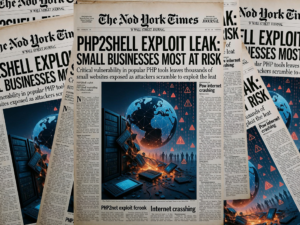
- Oct 17–21, 2026 — PHP2Shell & eMudhra Weak Keys: Emergency patches dropped on October 21 for PHP2Shell (CVE-2026-109618 and CVE-2026-109619), a critical remote code execution vulnerability in PHP affecting WordPress, Drupal, and Joomla—just days after the eMudhra weak-key Certificate Authority incident forced emergency browser revocations.
- Oct 2026 — Ahold Delhaize & French Supermarket Attacks: Grocery giant Ahold Delhaize (Stop & Shop, Food Lion, Giant) took systems offline after malicious activity disrupted online services and supply chains, while separate attacks targeted refrigeration and freezer controls across hundreds of French supermarkets.
- Oct 29, 2026 — Binance Hot Wallet Incident: Unauthorized withdrawals hit Binance hot wallets (estimated around $6.34B affected, with roughly $2.85B frozen or intercepted).
- Nov 3, 2026 — mSecure Password Manager Incident: mSeven Software warned users after a security incident involving the potential theft of encrypted password vaults.
- Early Nov 2026 — GitBook SSO Breach: Attackers exploited a single sign-on (SSO) flaw, exposing API/integration tokens, secrets, and access to connected GitHub and GitLab repositories.
- Nov 4, 2026 — Queens Public Library Ransomware: A ransomware attack knocked out websites, apps, public computers, Wi-Fi, and checkout systems across 66 New York City library branches.
- Nov 9, 2026 — Vanderbilt University Ransomware: The BYOD ransomware group claimed an attack on Vanderbilt that forced restrictions across campus devices, systems, and cloud services.
- Nov 10, 2026 — RIKEN / Fugaku Supercomputer Breach: Unauthorized access to internal servers forced Japan’s RIKEN institute to take the Fugaku supercomputer offline, exposing user details along with SSH and access keys.
- Nov 2026 — Nitori Breach: Major retailer Nitori disclosed the potential exposure of up to 37.62 million customer records (names, emails, addresses, phone numbers, and birthdates).
- Nov 15, 2026 — Bitly Link Hijacking: Bitly suffered an incident involving the hijacking of shortened links—a textbook example of how relying on third-party redirect and cloud middlemen creates instant risk.
- Nov 16, 2026 — Optimizely Supply-Chain Script Injection: Attackers compromised website optimization vendor Optimizely, injecting malicious scripts across major sites relying on its code—including the BBC, CNN, Zoom, Salesforce, IKEA, HSBC, Equifax, and GitLab.
- Nov 17–19, 2026 — Visa, Mastercard & JPMorgan Chase Third-Party Vendor Leak: Following a third-party service provider breach in Asia Pacific, hackers leaked marketing data—including customer names and email addresses—belonging to JPMorgan Chase, Visa, and Mastercard users.
- Nov 21, 2026 — FBI & USDA Breaches Reported: Reports surfaced that hackers breached a USDA farm payments system and the FBI’s National Crime Information Center (NCIC) database—the FBI’s second breach in months—right as the White House fired National Cyber Director Sean Cairncross amid the mounting wave of outages.
Why I Refuse to Hoard Your Data
We are living in a world where centralized data is a liability, not an asset.
This is the exact reason I created TechingAPPS. My design philosophy has always been to limit exposure, reduce dependency on third-party cloud storage, and insist that my clients do not hoard customer data that isn’t strictly necessary to run their business.
I’m building a new platform right now, and I hit a fork in the road: should we store our customers’ end-user email addresses on our servers so we can automatically send out subscription license alerts, or not?
I chose not to hold that data. It adds an extra step for the customer, and I’m fine with that—because it completely absolves my business from holding someone else’s customer list on a cloud server. Sometimes a workflow needs an extra step to protect you from catastrophic liability.
Be Prepared for the Next One
Back to my concrete assumption: I don’t believe these outages are simply old infrastructure crumbling on its own. I believe we are under attack. And the timeline above backs it up.
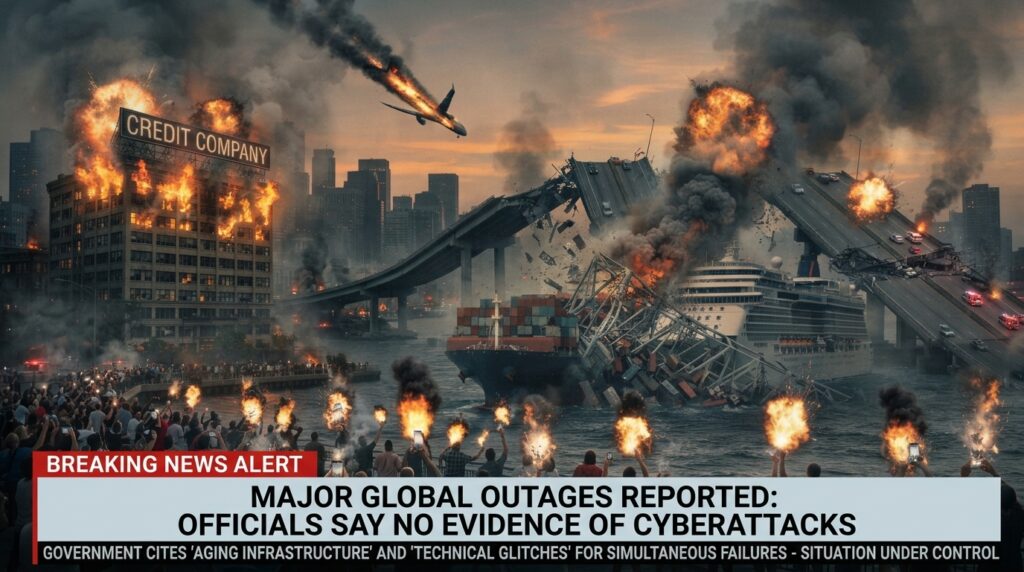
We may never be told the full scope of the threat for “national security reasons.” Time and time again, the public is told that everything is fine—right until the next train derails, the next barge slams into a bridge or cruise ship, and officials tell you not to worry, it’s just aging infrastructure.
I can’t tell you the exact origin of every outage, breach, or service disruption. All I can tell you is to prepare for the next one—because next time, it might be your cloud storage provider, and you might be the one forced to write a breach notification letter to every customer you have.
EDIT: 11/22/2026 1:30AM
After writing this, it came to my attention that the FBI’s National Crime Information Center (NCIC), the nationwide law enforcement database used to share warrants, missing persons reports, protection orders, stolen vehicle records, and criminal/background data including firearms purchases was reportedly hacked.
As reported by outlets including CNN, the Associated Press, and Fox News Digital, the FBI is investigating an apparent breach of NCIC, marking the second reported intrusion involving an FBI system in recent months.
While digging into what’s happening on the defense and intelligence side, I also came across a sobering Bloomberg report on the pressure inside our cyber and intelligence workforce:
“At least 11 National Security Agency and US Cyber Command workers died by suicide over roughly the past year, according to US officials and public records, a greater number than previously known.”
We don’t know everything that’s happening behind closed doors. We rarely do. We don’t have the full picture of every intrusion, every outage, or every pressure point inside these agencies.
But 11 people don’t die by suicide for no reason. And if we can barely keep up with how many government agencies and critical systems are getting breached, and we’re told not to call this an orchestrated attack, then what else are we supposed to think?