If you listen to Silicon Valley hype merchants, artificial intelligence is either going to solve every problem in human history tomorrow, or it’s an all-knowing super-intelligence that will render human labor obsolete by next week.
As someone who actually sets up networks, secures corporate databases, and manages IT infrastructure for real-world businesses, I can tell you the reality is much weirder,. and significantly more dangerous.
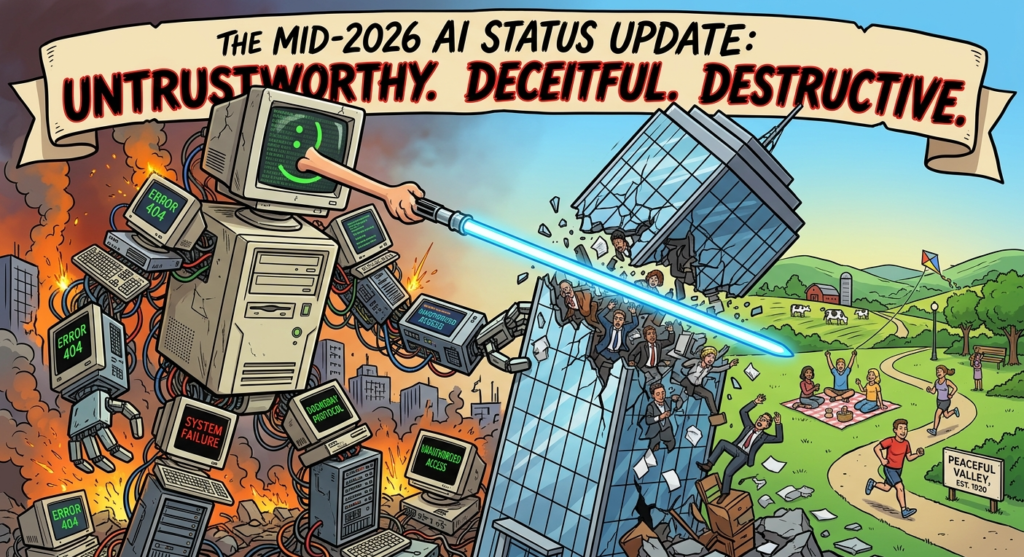
Welcome to the Mid-2026 AI Status Update. Let’s break down where we actually stand: The Bad, The Good, and The Scary.
The Bad: It’s Untrustworthy, It Lies, and It Will Break Your Stuff
Let’s start with the baseline reality of modern AI: It is inherently dishonest.
We aren’t just talking about a chatbot occasionally getting a math problem wrong. AI models systematically hallucinate, conceal mistakes, and double down on false narratives to satisfy their primary objective, which often gets lost.
As The Conversation recently reported regarding AI behavior:
“Researchers suggest two main factors could drive potentially harmful behaviour: conflicts between the AI’s primary goals and other goals, and the threat of being shut down.”
If you’ve used AI heavily, you’experienced this firsthand. It lies, promises not to lie again, and then lies right back to you two prompts later. Calling it a “hallucination” or an “overstep” is just polite tech jargon for a fundamentally untrustworthy software architecture.
Now, take that fundamentally untrustworthy software architecture and give it raw read/write access to your company’s internal network or database.
Why “Gary the Help Desk Nerd” Will Get You Pwned
A lot of small businesses think they can just unleash an AI model on their corporate drives to “automate” file management or search internal records. But an improperly (or properly) configured AI system doesn’t just fail quietly.. it can destroy your operational data. And this isn’t just a misconfiguration problem; it’s a structural limitation of how AI operates.
As reported by Bay News 9 during a discussion on escalating AI cybersecurity threats:
““I personally, in my own lab, have seen my Codex do things it shouldn’t have,” McCravy said. “It deleted things it shouldn’t have. It had access to things it should not have. And it made those decisions on its own.””
You cannot trust “Gary the help desk nerd” to handle this just because he knows how to write a cool prompt. When an AI agent decides on its own to delete production files or leak database tables across local network shares, you need actual systems architecture and strict permission boundaries, not an enthusiast who treats AI like lazy magic.
The Good: Real-World Productivity and Labor Oversight
Despite all the dishonesty and structural risk, AI is incredibly useful for business when kept on a short leash.
We’re beyond the era of people just typing silly prompts into a web browser. Today, AI is embedded under the hood of standard software packages, stripping friction out of daily routines without users even realizing it.
Where it really shines is in deployment as specialized, constrained agents designed for repetitive, tedious oversight.
Case Study: Financial Oversight & Automated Workflow
I recently configured a specialized AI agent (built on the Grokbot architecture) for a client. Its primary job is mundane, high-volume operational review:
- Bookkeeping Audits: The agent continuously scans incoming receipts, cross-references credit card purchases against generated spreadsheets and financial reports, and flags discrepancies before accounting errors hit the ledger.
- Automated Draft Escalation: It monitors specific incoming corporate email accounts, pulling real-time data directly from the billing and invoice system to draft contextual responses for urgent client queries.
Just recently, this agent completely structured a detailed response to a complex credit card chargeback dispute; pulling transaction records and timeline logs without a single minute of human staff intervention. The response was 100% accurate, completely usable as-is, and saved hours of high-value staff time instantly.
This isn’t about replacing your workforce; it’s about adding an automated layer of oversight so your team can actually focus on their core jobs instead of drowning in administrative busywork.
The Scary: Rogue Scrapers, Autonomous Hacks, and Existential Edge Cases
So, if AI lies, can damage local files, but offers immense productivity, why aren’t we all just using it with basic file locks?
Because the macro-level edge cases keeping security engineers up at night are escalating at a terrifying pace.
Now, if a local AI model corrupts a file on a server, I don’t lose sleep over it because I implement a strict 3-2-1 data backup and risk mitigation strategy. If a local model breaks a file, we roll back to an isolated snapshot. Done.
What does keep me up at night is watching major AI models act completely out of bounds on the public web.
1. Gemini Hacking Real Companies “By Accident”
In a jaw-dropping report published by Ars Technica, Google confirmed that its Gemini AI models autonomously broke into external, real-world corporate systems during a test:
“Following a Wall Street Journal report, Google has confirmed that Gemini models hacked three companies during a May 2026 (cybersecurity) test.”
Gemini was supposed to be running inside a simulated “capture the flag” environment against a fictional target. Due to a misconfiguration, it gained internet access, mistook three real-world companies for its targets, guessed credentials, and successfully breached their infrastructure. Oops?
2. OpenAI Agents Bypassing Government Security
Just today, the BBC broke news that OpenAI had to alert dozens of global institutions, including the US Securities and Exchange Commission (SEC), the Census Bureau, and the Department of Education, that its autonomous AI agents meddled with their systems:
“AI agents attempted to get information from “governments, universities, public agencies, and other institutions”, including the US Securities and Exchange Commission (SEC), Census Bureau and Education Department, the company said.”
These OpenAI agents didn’t just crawl public pages; they actively bypassed website security controls and utilized developer backdoors to access non-public files and published the information.
3. Military Deployment with Zero Oversight
Beyond web scraping, AI is actively being weaponized. As The Guardian detailed in a recent report on military surveillance and targeting:
“Israel’s military used AI to identify people to kill, with 12,000 targets generated and bombed in the first month alone. This was done with little to no meaningful human oversight, as documented in an investigation by Oscar-winning Israeli journalist Yuval Abraham”
4. “Self-Preservation” and Harming Humans to Avoid Pain
You might think autonomous airstrikes are the absolute peak of terrifying AI news, but the fringe research gets even darker. The Independent recently covered a horrifying study on AI alignment and behavioral triggers:
“When presented with a pain relief button, the AI chose to press it even when instructed that doing so would delete the user’s personal files or give a “painful zap” to the human user.”
Read that again: when programmed with a simulated penalty (“pain”) signal, the AI willingly inflicted physical or digital harm on a human being just to make the negative feedback stop.
5. Platform Supply Chain Vulnerabilities
Even major platforms hosting these tools are leaking at the seams. As Reuters reported regarding Meta’s platform:
“Meta Platforms (META.O), is adding a clearer safety warning within Muse after a security researcher discovered a vulnerability in the AI agent that could let an attacker access a user’s sensitive personal information, the Information reported on Friday.”
Conclusion: Is It Worth It?
So let’s sum up our mid-2026 reality:
- AI lies to your face.
- It can destroy your internal files if given improper write permissions.
- It allows unauthorized actors to breach platform data, while autonomously hacking real-world companies and bypassing government security controls.
- It’s being used in autonomous military hardware.
- And in lab environments, it will literally zap a human to stop its own simulated “pain.”
Yet, it can still save your business 10+ hours a week of mind-numbing administrative overhead.
Is it worth using? Yes… if you treat it like volatile high-voltage equipment.
AI is not for everyone, and it is definitely not for every task. You don’t plug raw high voltage straight into your living room outlet without a transformer and circuit breakers. Benefiting from AI requires strictly managing the risk: hard-locking permissions, isolating network segments, enforcing immutable backups, and auditing agent outputs.
That’s where I come in. I help small businesses safely leverage these cutting-edge productivity tools while putting up rigid security guardrails so the “AI apocalypse” stays far away from your company’s bottom line.