You step into your car, throw your bag in the passenger seat, and fire up your phone. You tap your favorite Spotify playlist, the one designed to help you forget where you’re commuting to, and pull out onto the road.
It feels seamless. It feels convenient. But while you’re listening to music, your car’s digital microcomputers are quietly working overtime.
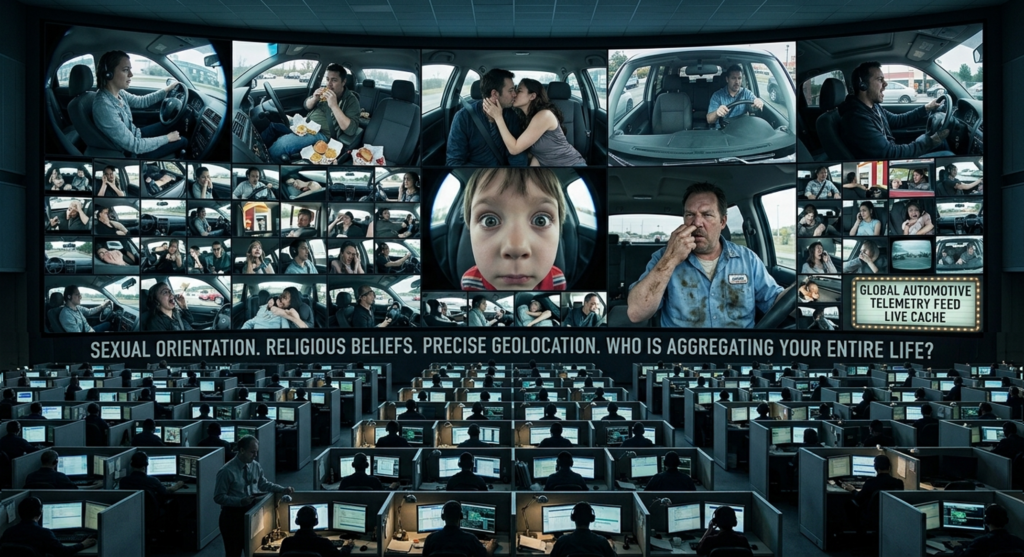
Not just to keep you in your lane, but to harvest every piece of personal data they can scrape off your body and your phone, package it up, and broadcast it to corporate cloud servers, where it can be packaged and sold, and resold, forever.
The modern automobile is no longer a machine that gets you from Point A to Point B. It is a data-collection engine on wheels. And short of driving a 40-year-old vehicle, your options to stop it are practically non-existent.
Big Tech’s Newest Data Goldmine
A landmark study from Northeastern University, cited by Consumer Reports, revealed the staggering extent to which connected cars siphon information the moment you turn the vehicle on.
Where is that data going? As Consumer Reports noted:
“The top recipients of the driver data were some of the country’s largest tech companies, including Amazon, Google, Meta, Microsoft, Pinterest, Snap, and Yahoo.”
Think about that list. Yahoo.. a brand that quietly transformed from the worst search engine to the worst email provider, has now cemented its place as one of the primary data brokers harvesting telemetry from your daily commute. They’ve been hacked egregiously, repeatedly. Do you trust them? Do you have a choice?
Federal Warnings vs. Mandated Surveillance
This isn’t happening in a regulatory vacuum. Regulators have known about this for years. Back in 2024, the Federal Trade Commission (FTC) issued a stern toothless warning directly to auto manufacturers:
“Car manufacturers—and all businesses—should take note that the FTC will take action to protect consumers against the illegal collection, use, and disclosure of their personal data.”
The FTC explicitly outlined that the surreptitious disclosure of precise geolocation data and sensitive driver info crosses the line into unlawful trade practices.
Yet, here is the delicious irony: while regulatory agencies issue warnings about unauthorized data collection, Congress passed the Infrastructure Investment and Jobs Act, which included an advanced impaired driving prevention mandate. This legislation effectively forces automakers to install driver-facing cameras and biometric sensors inside vehicle cabins to detect distraction or intoxication.
The government mandates the physical surveillance hardware under the banner of safety and automotive corporations immediately weaponize that same hardware to generate ad-targeting revenue.
Tracking You Even When the Engine Is Off
If you think this data harvest is limited to your speed or GPS coordinates, look at what automakers explicitly write into their privacy terms.
According to Nissan’s official privacy policy, the company reserves the right to collect:
“Sensitive personal information, including driver’s license number, national or state identification number, citizenship status, immigration status, race, national origin, religious or philosophical beliefs, sexual orientation, sexual activity, precise geolocation, health diagnosis data, and genetic information.”
Let that sink in. They aren’t just logging how fast you take a corner. They are mapping your identity, your belief systems, your demographic status, and what happens inside the vehicle with your wife.
A broader study of 25 major car brands conducted by the Mozilla Foundation and highlighted by The Guardian revealed an industry-wide failure:
“A study of 25 car brands found they all failed consumer privacy tests carried out by internet-focused non-profit Mozilla Foundation. Its research found that 84% of car companies review, share or sell data collected from car owners.”
Who are they gathering this intel for? Is it just data brokers like Yahoo? Insurance underwriters looking for a reason to raise your premiums? Third-party marketing networks? The government?
The short answer is: we don’t know.
The Illusion of “Opting Out”
Automakers love to claim that all of this telemetry collection is strictly “opt-in.” But calling it voluntary is a bad joke.
In the joint Northeastern University and Consumer Reports research, scientists highlighted what happens when a driver actually attempts to decline a privacy agreement. When a Tesla owner attempts to opt out of data sharing, they are confronted with an explicit warning stating that declining the agreement may result in:
“…reduced functionality, serious damage, or inoperability.”
That is not “informed consent.” That is an ultimatum: Hand over your digital autonomy, or risk bricking your $50,000 investment.
What Can You Actually Do?
So what options do you have if you don’t want your daily commute packaged and sold off?
- Audit Mobile App Permissions: The car’s companion mobile app is often the worst culprit for scraping device data. Limit its background location tracking and Bluetooth access. Or just don’t install it at all.
- Be Smart About Bluetooth & Infotainment: While Apple CarPlay and Android Auto sand-box your data reasonably well, connecting your smartphone directly to a car’s native infotainment system over raw Bluetooth or USB is functionally handing the vehicle full access to your contacts, call logs, text history, and maybe photos of your cat.
- Submit Data Deletion Requests: You can technically lodge opt-out and deletion demands with major data brokers (though success rates vary wildly).
- The Nuclear Option (Hardware Disconnect): For privacy-conscious clients, we sometimes go so far as physically pulling the fuse for the Telematics Control Unit (TCU). This cuts off the car’s cellular modem entirely. The catch? You instantly lose onboard GPS, remote start features, and the manufacturer’s automated safety assistance.
When I drive up to a client site in my 1987 Mercedes-Benz 300D, people sometimes look at it and ask why I rely on a classic diesel. They ask if it’s reliable.
I tell them the same thing every time: I can reliably guarantee that my car isn’t spying on me.
Until consumers demand strict, hardcoded hardware privacy toggles, we are stuck in an unpleasant compromise: trade away every shred of personal privacy, or find yourself a classic car.
The Weaponized Data Breach: When Your Private Life Hits the Dark Web
It’s bad enough that automakers package up your identity, immigration status, and cabin activity to sell to third-party data brokers. It’s infinitely worse when you look at who is holding the keys to that vault.
Yahoo, for instance, isn’t just a bottom-tier data broker. They are infamous for executing the largest data breaches in human history, compromising billions of user accounts across multiple catastrophic security failures.
So what happens when a third-party aggregator holding your precise geolocation history, your religious affiliation, immigration status, and your intimate cabin telemetry gets breached?
You don’t have to guess. That data doesn’t just sit on a server; it gets leaked, dumped onto dark web marketplaces, and weaponized against you.
- Extortion & Blackmail: When a broker leaks detailed logs regarding a driver’s location, religious beliefs, or sexual orientation, it opens the floodgates for targeted blackmail, harassment, and corporate espionage.
- Identity Fraud on Steroids: A stolen social security number is bad, but a leaked profile combining your government ID, daily route patterns, citizenship status, and personal relationships gives bad actors everything required to completely hijack your identity.
- Precision Phishing & Stalking: Malicious actors don’t need to guess your routines anymore. A leaked telemetry database tells a stalker or burglar exact habits: when you leave for work, where you park, when the car is idling, and who is inside with you.
We aren’t just trusting auto manufacturers and tech brokers with our convenience. We are handing over incredibly sensitive biometric and behavioral profile data to companies that have proven, repeatedly, that they cannot secure their own infrastructure.